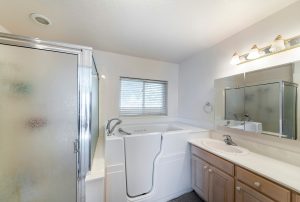


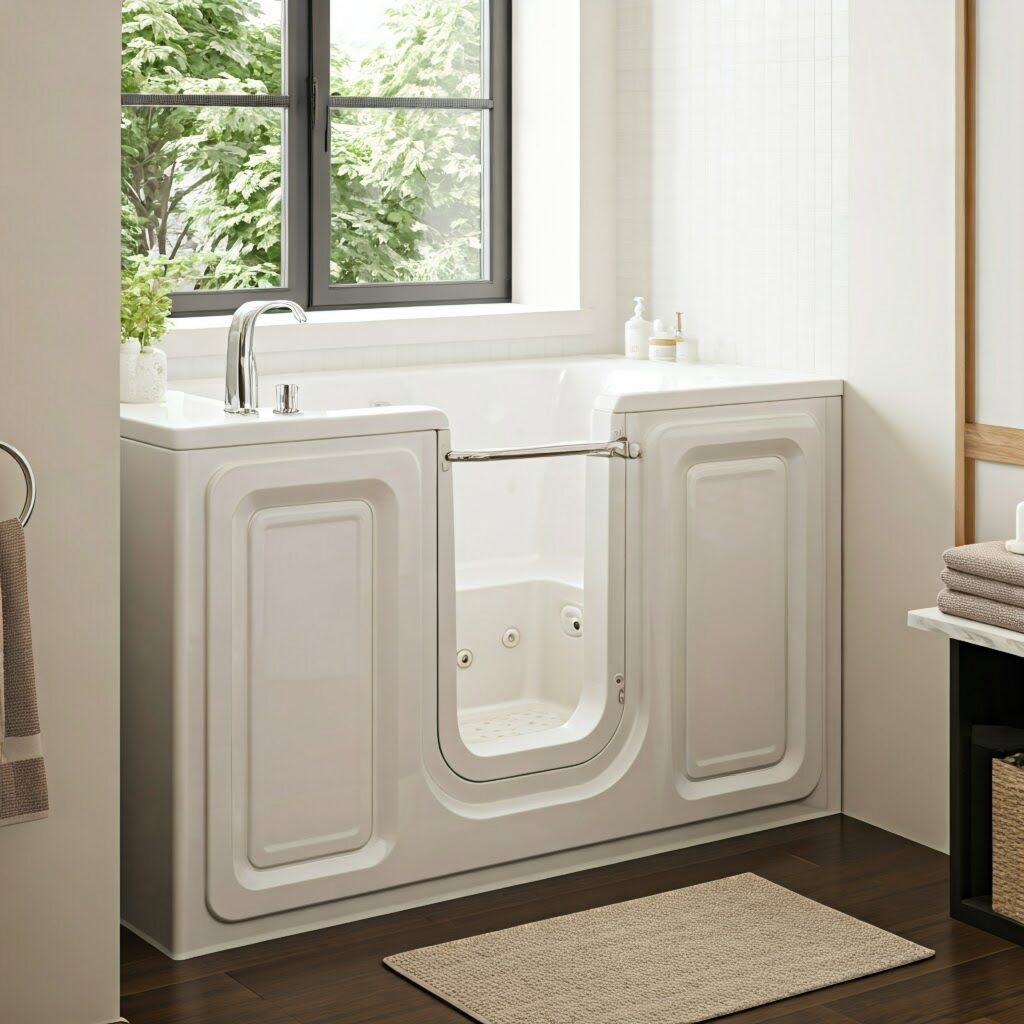
A standard walk-in tub measures roughly 52 inches long, 30 to 32 inches wide, and 38 inches tall. That’s compact enough to replace most existing bathtubs without a major remodel. Getting the dimensions right matters more than you might expect, though. Choose a tub that’s too large and you’ll face expensive plumbing relocations. Pick one that’s too small and you’ll sacrifice comfort and safety.
Walk-in tubs range in size from compact 38-inch models designed for tight spaces to 84-inch two-person configurations built for couples or assisted bathing. This guide breaks down the specific dimensions for every type of walk-in tub, explains how to measure your bathroom accurately, and covers the ADA clearances and plumbing specs that most size guides overlook.
Quick Reference: Walk-In Tub Dimensions by Type
| Tub Type | Typical Length | Typical Width | Typical Height | Water Capacity |
|---|---|---|---|---|
| Compact | 38″ to 48″ | 26″ to 30″ | 38″ | 40 to 55 gal |
| Standard Soaker | 52″ to 60″ | 30″ to 32″ | 38″ | 50 to 70 gal |
| Whirlpool/Hydrotherapy | 52″ to 60″ | 30″ to 32″ | 38″ to 40″ | 50 to 70 gal |
| Bariatric | 60″ | 32″ to 35″ | 38″ to 50″ | 70 to 95 gal |
| Two-Person | 60″+ | 38″ to 42″ | 38″ to 42″ | 100+ gal |
| Tub-Shower Combo | 52″ to 84″ | 28″ to 32″ | 38″ to 46″ | 50 to 70 gal |
What Are Standard Walk-In Tub Dimensions?
Standard walk-in tubs are between 52 and 60 inches long, 28 to 32 inches wide, and 38 to 39 inches tall. These dimensions are designed to drop into the same footprint as a conventional bathtub, which is typically 60 inches long and 30 to 32 inches wide.
The key difference is height. A traditional tub stands only 14 to 16 inches tall, while a walk-in tub’s extra height accommodates a built-in seat and deeper soaking depth. Most walk-in tubs include a 17-inch-high ADA-compliant seat and a step-in threshold of 2 to 4 inches. Ultra-low threshold models sit as low as 1 to 2 inches. When choosing a walk-in tub, avoid any model with a threshold over 5 inches, since that defeats the purpose of a low-entry mobility product.
Internally, the bathing depth typically reaches about 30 inches, allowing for shoulder-level soaking while seated upright. Because these tubs fit within a standard bathtub alcove (a three-walled space measuring 60 inches long and 30 to 32 inches wide), most homeowners won’t need to move walls or fixtures to accommodate one. That’s a significant advantage, since relocating plumbing lines more than three feet can add $1,000 or more to installation costs.
How Do Walk-In Tub Dimensions Compare to Standard Bathtubs?
A walk-in tub occupies a similar floor footprint to a standard bathtub but stands about 24 inches taller and weighs significantly more when filled. Here’s how the two compare:
| Dimension | Standard Bathtub | Standard Walk-In Tub |
|---|---|---|
| Length | 60″ | 52″ to 60″ |
| Width | 30″ to 32″ | 28″ to 32″ |
| Height | 14″ to 16″ | 38″ to 39″ |
| Water Capacity | 25 to 45 gal | 50 to 70 gal |
| Filled Weight (with bather) | ~400 to 550 lbs | ~850 to 1,000+ lbs |
| Floor Load | ~30 to 40 psf | ~80 to 85 psf |
The filled weight is an important detail that many size guides overlook. Water weighs approximately 8.34 pounds per gallon. A standard walk-in tub filled to 60 gallons holds roughly 500 pounds of water alone. Add a 200-pound tub shell and a 200-pound bather, and you’re looking at 850 to 1,000+ pounds concentrated in a small footprint. Standard US residential bathroom floors are built for a live load of 40 pounds per square foot (psf) under the International Residential Code (IRC). A filled walk-in tub can exert roughly 80 to 85 psf, doubling that standard load limit. Second-floor installations almost always need a structural evaluation before moving forward.
The higher water capacity also affects your water heater, but perhaps not as dramatically as you’d think. When bathing, you mix hot water (typically set at 120°F) with cold tap water (50°F to 70°F) to reach a comfortable temperature around 100°F. A 50-gallon hot water tank can actually produce well over 60 gallons of mixed bathwater at bathing temperature. Most standard tanks handle a standard-sized walk-in tub without issue. If you’re choosing a bariatric or two-person tub that holds 80 gallons or more, that’s when you should consider upgrading to a larger tank or a tankless water heater. The Department of Energy’s water heater sizing guide explains how to calculate your first-hour rating to determine whether your current system is adequate.
Actual costs depend on your location, project scope, and materials. The best way to know what you'll pay is to get quotes from local contractors.
Get Your Free Estimate →What Size Walk-In Tub Do You Need by Type?
Walk-in tubs come in several types, and each type has its own typical size range. Understanding these categories helps you narrow your options before measuring your bathroom.
Compact Walk-In Tubs
Compact models are designed for smaller bathrooms, apartments, or spaces where a standard tub won’t fit. These tubs range from 38 to 48 inches long and 26 to 30 inches wide. The trade-off is a smaller bathing area and a shallower soaking depth. Compact tubs typically hold 40 to 55 gallons and work best for people of average or smaller stature. Keep in mind that the smallest models may not be wheelchair accessible and may feel cramped for taller users.
Standard Soaker Walk-In Tubs
The most common walk-in tub type, standard soakers measure about 52 inches long, 30 to 32 inches wide, and 38 inches tall. They feature a built-in seat, a low-threshold door, grab bars, and a hand-held showerhead. Soaker tubs hold 50 to 70 gallons and deliver a deep, seated bath. Because they fit most standard tub alcoves, they’re the easiest to install and the most affordable walk-in option.
"We matched with a great contractor the same day. The whole process was easy and completely free."
Whirlpool and Hydrotherapy Walk-In Tubs
Whirlpool and air jet walk-in tubs have the same exterior dimensions as standard soakers, generally 52 to 60 inches long and 30 to 32 inches wide. The difference is internal: they include water jets, air jets, or both, which require additional plumbing and electrical connections. The jets don’t change the tub’s footprint, but installation is more complex. A dedicated GFCI-protected electrical circuit is typically required, and the tub accessories add mechanical components that need periodic maintenance access (more on that below).
Bariatric Walk-In Tubs
Bariatric walk-in tubs are built wider and sturdier for users over 300 pounds. They typically measure about 60 inches long, 32 to 35 inches wide, and up to 50 inches tall. The wider door opening, usually 20 inches or more compared to the standard 17 to 18 inches, provides easier entry. Length matters here: bariatric users need more legroom, not less, so these tubs maintain a full 60-inch length rather than downsizing. Bariatric models can hold 70 to 95 gallons and may require a floor load assessment, since the filled weight can exceed 1,200 pounds.
Two-Person Walk-In Tubs
Two-person or companion walk-in tubs are the largest standard option. These tubs are usually 60 inches or longer and 38 to 42 inches wide, with dual seating, twin headrests, and center-mounted faucets. They can hold 100 gallons or more, and their size almost always requires custom plumbing work and a bathroom layout that can accommodate the wider footprint. Before purchasing, confirm that your bathroom can handle the added floor space, the larger drain requirements, and the door clearance on both sides of the tub.
Walk-In Tub-Shower Combos
A tub-shower combo pairs a walk-in tub with a built-in showerhead, typically a rainfall showerhead and adjustable shower arm. The exterior dimensions generally match a standard walk-in tub (52 to 60 inches long, 28 to 32 inches wide), although some combo models extend up to 66, 72, or even 84 inches in length. These longer models may require a larger alcove or a complete bathroom reconfiguration. If you’re weighing this option against a standalone shower, our guide to walk-in tubs vs. walk-in showers breaks down the pros and cons of each.
How to Measure Your Bathroom for a Walk-In Tub
Choosing the right walk-in tub size starts with accurate measurements of your existing space. Even if you’re confident your bathroom is “standard,” precise measurements prevent costly surprises during installation. Follow these steps in order:
- Measure the alcove footprint. Measure the length along the back wall (end to end), the width from the back wall to the front edge, and the height from the floor to the top edge of your existing tub. Standard US alcoves are 60 inches long and 30 to 32 inches wide.
- Check your doorway clearances. Walk-in tubs need to physically pass through your home to reach the bathroom. Measure the width of your bathroom doorway. Standard interior bathroom doors in the US are often 24 to 28 inches wide, which means a 30- or 32-inch-wide tub will not fit through without removing the door frame or stripping the tub’s exterior panels. Installers routinely deal with this, but you need to know about it before purchase day.
- Map the tub door swing. Walk-in tub doors come in two styles: inward-swinging and outward-swinging. Outward-swinging doors require additional floor clearance in front of the tub. For wheelchair transfer access, an L-shaped outward-swinging door creates a 30-inch or wider opening along the full side of the tub, significantly larger than the standard 17- to 20-inch U-shaped door. Map this radius on your bathroom floor to confirm it clears the toilet, vanity, and any other fixtures.
- Plan for the access panel. Tubs with hydrotherapy jets, fast-drain pumps, or inline heaters require a dedicated mechanical access panel, typically 12 by 12 inches or 14 by 14 inches, to reach motors and GFCI outlets for maintenance. This panel cannot be blocked by a toilet, vanity, or wall. Factor this into your floor plan before purchase.
- Verify your drain pipe size. Standard US residential drain lines are 1.5 inches in diameter. Many walk-in tubs with fast-drain technology require a 2-inch drain line to empty the tub in a reasonable time frame. Slow drain times are the number one complaint among walk-in tub owners, so check your existing drain size and budget for a potential upgrade. A plumber can assess this during a pre-installation visit. The International Plumbing Code (IPC) provides the standards for fixture drain sizing.
- Evaluate the floor structure. As noted in the comparison table above, a filled walk-in tub can exert double the standard residential floor load. For any installation above the ground floor, have a contractor evaluate your floor joists before you purchase. This assessment should happen during the planning phase, not on installation day.
- Get a professional to confirm final measurements. While preliminary measurements are yours to take, a professional installer should confirm the final dimensions. They’ll account for variables like plumbing pipe placement, wall thickness, electrical outlet locations, and drain positioning. Most walk-in tub companies offer free in-home consultations as part of their quoting process.
Why Hire a Licensed Professional
- Licensed & insured — protects you from liability
- Warranty coverage — manufacturers require pro installation
- Code compliance — avoids permit issues
- Faster completion — pros finish in days, not weeks
What Are the ADA Requirements for Walk-In Tub Dimensions?
Walk-in tubs are not automatically ADA-compliant just because they have a door and a seat. To meet the requirements outlined in Section 607 of the 2010 ADA Standards for Accessible Design, a tub must include several specific dimensional and safety features.
Key ADA dimensional requirements include:
- Clear floor space: Minimum 30 inches wide by 60 inches long alongside the tub for a parallel wheelchair approach.
- Tub seat: Must be securely mounted with stable handholds on both sides. Seat height must be 17 to 19 inches.
- Grab bars (back wall): At least 48 inches long, positioned with one bar 9 inches above the tub rim and another at 33 to 36 inches above the floor.
- Grab bars (foot of tub): Minimum 24 inches long, measured from the outer edge.
- Controls: Must be operable with one hand, without tight gripping, pinching, or twisting. Located between the open edge and the midpoint of the tub.
- Showerhead hose: If a handheld showerhead is included, the hose must be at least 60 inches long.
- Enclosures: Cannot obstruct controls, faucets, or wheelchair-to-seat transfers.
One often-overlooked detail: standard inward-swinging doors do not meet strict ADA guidelines for wheelchair transfers. The door swings into the tub’s internal space, blocking the path for a lateral transfer from a wheelchair. True ADA-compliant wheelchair access typically requires an outward-swinging L-shaped door that opens up the entire side of the tub, creating a 30-inch or wider opening. If you’re also updating other fixtures, our guide on ADA-accessible toilet height requirements covers the companion standards for toilets. For grab bar placement, specific height and length rules apply to both tubs and showers.
ADA compliance is legally required in public accommodations like hotels, hospitals, and assisted living facilities, not in private homes. However, homeowners planning to age in place often choose ADA-compliant tubs because they offer the highest level of safety. If you’re interested in financial assistance for accessibility upgrades, check whether your situation qualifies for a tax deduction on your walk-in tub or explore bathroom remodel grants and assistance programs.
What Are the Best Walk-In Tub Dimensions for Small Bathrooms?
Compact walk-in tubs measuring 38 to 48 inches long and 26 to 30 inches wide can fit into spaces where a full-length tub wouldn’t work. The key is to match your new tub to the footprint you already have rather than trying to force a larger model into a tight space.
Safe Step offers a compact model at 47 inches long by 28 inches wide, while Kohler’s walk-in bath can be customized down to 52 inches long and 28 inches wide. For extremely tight layouts, some manufacturers produce “cub” models as short as 38 inches, though these are best suited for smaller users and won’t accommodate wheelchair access.
Practical tips for small bathroom installations:
- Choose an inward-swinging door to preserve floor space in front of the tub.
- Select a model with a corner drain to align with your existing plumbing.
- Consider a tub-shower combo to maintain showering capability without adding a separate stall.
- If your bathroom doorway is narrow, confirm with the installer that the tub can physically be carried into the room. Door frame removal is common for wider tubs passing through 24- to 28-inch doorways.
Walk-In Tub Dimensions by Brand
Major walk-in tub brands offer slightly different standard sizes. This comparison covers the physical dimensions. For pricing details, see our walk-in tubs cost guide.
| Brand | Length Options | Width Options | Step-In Threshold | Notable Sizing Feature |
|---|---|---|---|---|
| Kohler | Custom, 52″ to 60″ | 28″ to 32″ | 3″ | Fits standard alcoves; 21.5″ wide seat |
| Safe Step | 47″, 51″, 53″ | 28″, 31″ | 2″ to 4″ | Three fixed sizes; compact option |
| American Standard | 48″ to 60″ | 30″ to 32″ | Varies | Standard alcove fit; quick-drain tech |
| Ella’s Bubbles | Varies, 60″+ for two-seater | Up to 42″ | Varies | Two-person models; dual jet systems |
DIY vs. Professional: At a Glance
Kohler
Kohler tubs are designed to fit within the footprint of your existing bathtub. They offer the widest range of customization, with lengths adjustable from 52 to 60 inches and widths from 28 to 32 inches. Their interior seat measures 17 inches high with 21.5 inches of seating width.
Safe Step
Safe Step offers three distinct sizes: a compact model at 47 by 28 inches, a standard at 51 by 28 inches, and a larger option at 53 by 31 inches. The most popular model stands 38.5 inches tall. All three are designed for quick installation in a standard bathroom.
American Standard
American Standard walk-in tubs span 48 to 60 inches long and 30 to 32 inches wide. They’re built to fit standard bathroom dimensions and feature quick-drain technology, which pairs well with a 2-inch drain line upgrade.
Spring and summer are the busiest seasons for home improvement projects — top-rated contractors book up fast. Lock in your estimate now before demand peaks.
Check Availability in Your Area →Ella’s Bubbles
Ella’s Bubbles specializes in larger configurations, including two-seater tubs with independent hydrotherapy and air jet systems. Their two-person models reach 60 inches or longer and up to 42 inches wide, making them the brand to consider if companion bathing is a priority.
How to Choose the Right Walk-In Tub Size
Selecting the right walk-in tub comes down to three factors: your bathroom’s physical dimensions, the user’s body size and mobility needs, and the infrastructure your home can support.
Ready to Move Forward?
Tell us about your project and get matched with up to 3 pre-screened contractors. Compare quotes, check reviews, and hire with confidence.
Match the Tub to Your Alcove
Start with your bathroom measurements. If a standard 52-by-32-inch tub fits your alcove, that’s the simplest path forward. Only upsize if you have a specific reason, such as a taller user who needs more legroom, a wider user who needs a bariatric model, or two people who want to share a bath.
Factor in Mobility and Access Needs
Consider the user’s mobility level. If the primary bather uses a wheelchair, you need a tub with an outward-swinging L-shaped door (at least a 30-inch opening) and enough clear floor space for a safe lateral transfer. Bariatric models with 30-inch-wide seats and extra-tall walls can accommodate users up to 400 pounds or more. If caregiver assistance is needed, make sure there’s enough clearance around the tub for a second person to help with entry and exit.
Check Your Home’s Infrastructure
Evaluate your plumbing, electrical, and structural capacity before committing. Check your drain pipe diameter (1.5-inch vs. 2-inch), your water heater’s first-hour rating against your chosen tub’s capacity, your floor’s load-bearing capacity (especially for upper floors), and the physical path the tub must travel to reach your bathroom. A bathroom renovation checklist can help you track all the moving parts. Once your tub is installed, follow a regular walk-in tub cleaning routine to keep it in good condition.
Bottom Line
Every bathroom is different, but the range of available sizes means there’s a walk-in tub for nearly any space. Measure carefully, plan for the access panel and drain requirements most people overlook, and get a professional to confirm your dimensions before you buy. The right-sized walk-in tub delivers years of safer, more comfortable bathing without the expense of a full bathroom remodel.
Connect with top-rated local contractors who can help you with siding, roofing, HVAC, windows, and more. Get free quotes from verified professionals in your area today.