


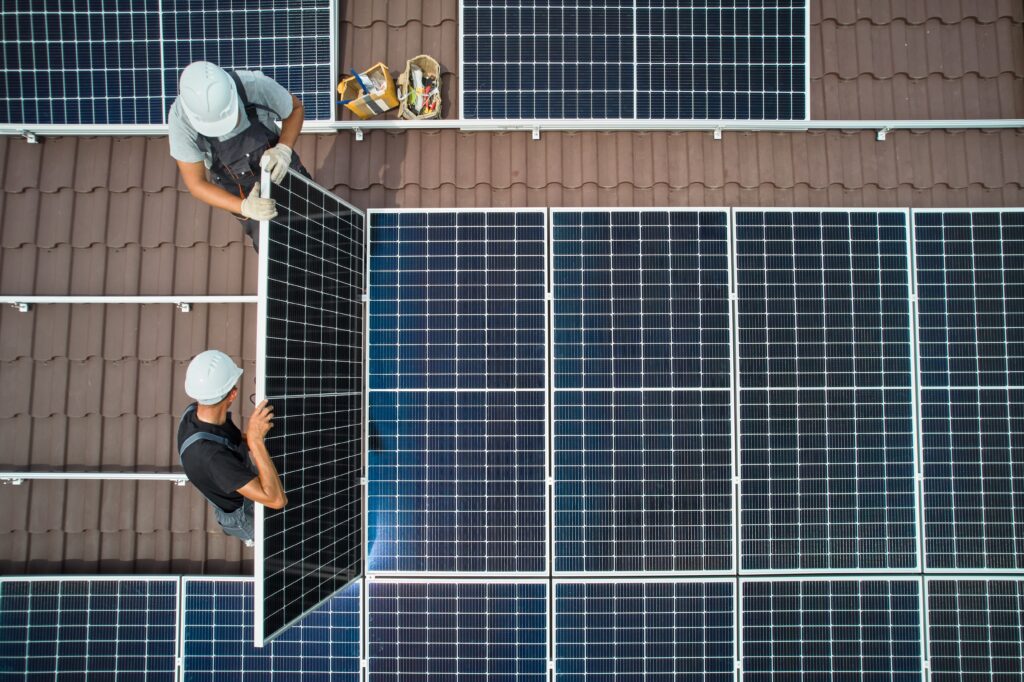
Installing solar panels on your home costs between $15,000 and $30,000 for most residential systems, with the national average around $20,000 to $25,000. Understanding what drives these costs and how to evaluate the long-term financial benefits can help you make an informed decision about whether solar power makes sense for your home.
This guide breaks down everything that affects solar installation pricing, from system size and equipment quality to regional factors and financing options. You’ll learn how to calculate your potential return on investment and which factors matter most when comparing quotes from installers.
Average Solar Installation Costs by System Size
A solar power system costs scale with the size of your installation, measured in kilowatts (kW). Most residential systems range from 5 kW to 12 kW, depending on your home’s energy needs and available roof space.
| System Size | Total Cost | Price per Watt |
| 5 kW | $12,500-$17,500 | $2.50-$3.50 |
| 8 kW | $20,000-$28,000 | $2.50-$3.50 |
| 10 kW | $25,000-$35,000 | $2.50-$3.50 |
| 12 kW | $30,000-$42,000 | $2.50-$3.50 |
The average American home uses about 10,500 kilowatt-hours (kWh) of electricity annually, which typically requires a 7 to 10 kW solar system to offset completely. According to the U.S. Energy Information Administration, most homeowners aim for 80% to 100% energy offset to maximize savings while accounting for seasonal variations in solar production.
What Affects Solar Panel Installation Costs
Solar installation pricing varies significantly based on several key factors:
- Panel quality and efficiency ratings
- Inverter type and system design complexity
- Roof characteristics and installation difficulty
- Geographic location and local labor costs
- Battery storage additions
Panel Quality and Efficiency
Solar panels range from budget options at $0.70 to $1.00 per watt to premium high-efficiency panels at $1.20 to $1.50 per watt. Premium panels from manufacturers like SunPower or LG typically offer 22% to 23% efficiency compared to 17% to 19% for standard panels.
Higher-efficiency panels produce more electricity from the same roof space, making them valuable if you have limited roof area. Panel warranties also correlate with price, with budget panels offering 10 to 12-year product warranties and premium options providing 25-year comprehensive warranties. Most quality panels maintain at least 80% to 85% of original output after 25 years.
Inverter Selection and System Design
Inverters convert the DC electricity your panels produce into AC electricity your home uses. Your choice significantly impacts both cost and performance.
| Inverter Type | Cost Range | Best For | Key Feature |
| String Inverter | $1,000-$2,500 | Simple roofs, minimal shade | Most economical |
| Microinverters | $2,500-$4,000 | Shaded roofs, complex angles | Panel-level optimization |
| Power Optimizers | $2,000-$3,500 | Moderate shading issues | Hybrid approach |
Homes with minimal shading and simple roof layouts typically see excellent results with string inverters, while properties with multiple roof planes, nearby trees, or partial shading benefit from microinverters or optimizers.
Roof Complexity and Condition
Simple gable roofs with easy access represent baseline pricing. Multi-level roofs, steep pitches, or tile and slate materials add $1,000 to $5,000 to installation costs due to specialized mounting equipment and additional labor.
Important: Most installers recommend replacing your roof before solar installation if it has less than 10 to 15 years of life remaining. Removing and reinstalling solar panels to replace your roof later costs $2,000 to $5,000.
Location and Regional Labor Costs
Geographic location creates substantial price variations. High-cost markets like California, Massachusetts, and New York see average prices of $2.75 to $3.50 per watt, while states with lower labor costs range from $2.25 to $2.75 per watt. According to the National Renewable Energy Laboratory, local permitting fees vary from under $500 to over $2,000, with utility interconnection charges adding another $200 to $800.
Battery Storage Additions
Adding battery storage increases upfront costs by $8,000 to $15,000 for typical installations. The Tesla Powerwall (13.5 kWh capacity) costs around $11,000 to $12,000 installed, while Enphase IQ batteries range from $9,000 to $14,000.
Battery storage makes financial sense in specific situations:
- Areas with time-of-use electricity rates and significant peak/off-peak differentials
- Regions with frequent power outages requiring backup power
- Markets with limited or unfavorable net metering policies
Batteries can save $500 to $1,500 annually in markets with significant rate differentials between peak and off-peak periods.
State and Local Incentives
Many states and utilities offer incentives that can reduce costs by 10% to 25%. The Database of State Incentives for Renewables & Efficiency (DSIRE) maintains a comprehensive directory of available programs in your area.
New York’s Megawatt Block incentive program, California’s SGIP battery rebate, and Massachusetts’ SMART program provide substantial savings. Local utility companies sometimes offer upfront rebates or production-based incentives that pay you for every kilowatt-hour your system generates.
Property tax exemptions exist in many states, preventing your home’s assessed value increase from raising property taxes. Some states also exempt solar equipment from sales tax, saving another 5% to 10% on equipment costs.
Calculating Your Solar Return on Investment
Solar panel payback periods typically range from eight to 15 years depending on your electricity costs, system size, available incentives, and local solar production potential.
ROI Example:
Monthly electricity cost: $150 ($1,800 annually)
System cost: $25,000
Annual savings (90% offset): $1,620
Payback period: 15 years
After payback, savings become pure profit for the remaining 10 to 15 years of system life.
This calculation becomes more favorable when you account for electricity rate inflation. Utility rates historically increase 2% to 4% annually, meaning your first-year savings grow each subsequent year. According to the Solar Energy Industries Association, over 25 years, many homeowners save $30,000 to $70,000 compared to continuing to buy grid electricity.
Factors Affecting Production
Your location’s solar resource determines annual electricity generation. A 10 kW system in Arizona might generate 16,000 to 18,000 kWh annually, while the same system in Seattle produces 11,000 to 13,000 kWh. This production difference directly impacts savings and payback period.
Roof orientation matters too. South-facing roofs with a 30 to 40-degree pitch optimize production. East or west-facing installations produce about 15% to 20% less than ideal south-facing arrays, while north-facing roofs rarely make financial sense.
Solar Financing Options
How you pay for your solar system significantly impacts total cost and long-term savings.
| Financing Type | Upfront Cost | System Ownership | Best Long-term Value |
| Cash Purchase | Full cost | Yes | Highest |
| Solar Loan | $0 down typical | Yes | Good |
| Lease/PPA | $0 | No | Lowest |
Cash Purchase
Paying cash provides the best return on investment and simplest ownership. You maximize your 25-year savings since you avoid interest charges. Cash buyers see the shortest payback periods and highest lifetime value.
Solar Loans
Solar loans allow you to own your system while spreading payments over 10 to 25 years. Interest rates typically range from 3% to 8% depending on your credit and loan term. A $20,000 system financed at 5% for 20 years costs roughly $31,800 in total payments, adding $11,800 in interest.
Monthly loan payments often run lower than your previous electricity bill, creating immediate positive cash flow. Beware of dealer fees built into solar loans. Ask for both cash and financed pricing to identify any markup.
Solar Leases and PPAs
Solar leases and PPAs require no upfront cost but mean you don’t own the system. These arrangements typically save 10% to 30% compared to utility bills but capture far less value than ownership options. Lease agreements usually last 20 to 25 years with annual rate increases of 1% to 3%. Selling your home with a lease can complicate transactions since the lease must transfer to the buyer or be bought out.
Maintenance and Operating Costs
Solar panels require minimal maintenance. Expect to spend $100 to $300 annually, though some years may require no spending.
Professional cleaning services charge $100 to $300 per visit, though many homeowners in areas with regular rainfall skip this since production gains rarely exceed 5% to 10%.
Inverters typically require replacement once during the system’s 25 to 30-year life. String inverters last 10 to 15 years and cost $1,500 to $3,000 to replace. Microinverters last longer (20 to 25 years), potentially eliminating replacement costs.
Most modern inverters include basic monitoring through smartphone apps at no additional cost.
Finding and Evaluating Solar Installers
Installation quality affects your system’s long-term performance and satisfaction. Start by getting quotes from at least three to five installers to compare pricing, equipment options, and approaches.
Credentials to Verify
Solar installers should carry:
- General liability insurance of at least $1 million
- Workers’ compensation coverage
- Electrical contractor licenses (required in most states)
- Solar-specific licensing where applicable
Experience and Warranties
Look for companies with five or more years in your market and hundreds of local installations. Workmanship warranties matter significantly. Look for installers offering at least 10-year workmanship warranties, with premium companies providing 25-year coverage.
Key Questions to Ask
- What specific equipment brands and models are you proposing, and why? This reveals whether they’re recommending based on your needs or their profit margins.
- How did you calculate my system size and production estimates? Installers should base recommendations on your actual electricity usage, roof characteristics, and local solar resource data.
- What happens if my roof needs work during the warranty period? Clarify who pays for panel removal and reinstallation.
- How does your monitoring system work? Understanding their service protocols helps gauge long-term support quality.
- Do you handle permits and utility interconnection? Reputable installers manage the entire process.
Is Solar Worth It for Your Home?
Solar makes strong financial sense for most homeowners with suitable roofs and moderate to high electricity bills. Solar works best when you have:
- A south-, east-, or west-facing roof with minimal shade
- Plans to stay in your home at least seven to ten years
- Electricity bills of at least $100 to $150 monthly
Homes with these characteristics typically achieve payback within eight to 15 years and save tens of thousands over the system’s life.
Net Metering Considerations
States with full net metering credit you at retail rates for excess production you send to the grid, maximizing the value of your solar generation. Check your utility’s current net metering policy as it directly affects your financial analysis.
Impact on Home Value
Research shows solar installations typically increase home values by $15,000 to $25,000, roughly equivalent to the installed cost. This means even if you move before full payback, you may recoup your investment through increased sale price.
Next Steps
- Analyze your electricity usage. Review your past 12 months of utility bills to understand consumption patterns. Look for seasonal variations since this affects how much solar offsets your annual consumption.
- Evaluate your roof condition. Identify shade sources, note your roof’s orientation, and estimate its age. If your roof needs replacement soon, handle that before solar installation.
- Research available incentives. Check the DSIRE database for state and local incentives. Many utilities provide solar potential calculators that estimate production and savings based on your address.
- Request multiple quotes. Compare equipment quality, warranties, company reputation, and proposal comprehensiveness. A slightly higher quote from a well-established company often provides better value than the cheapest option.
- Take your time with the decision. Reputable installers respect your need to research options. The typical installation timeline is four to 12 weeks from contract signing to system activation.
Conclusion
Solar panel installation represents a significant investment that pays dividends for decades when done right. By understanding the costs, incentives, and factors that affect your return on investment, you can make an informed decision about whether solar makes sense for your situation and select an installer who will deliver quality work at a fair price.
Ready to find qualified solar installers for your home energy project? MyHomePros connects you with screened, licensed solar professionals in your area who can assess your roof’s suitability, design a system sized to your energy needs, explain available incentives and financing options, and provide transparent pricing for a quality installation.

Anna has over six years of experience in the home services and journalism industries and serves as the Content Manager at MyHomePros.com, specializing in making complex home improvement topics like HVAC, roofing, and plumbing accessible to all. With a bachelor’s degree in journalism from Auburn University, she excels in crafting localized, comprehensive guides that cater to homeowners’ unique needs. Living on both coasts of the United States has equipped her with a distinctive perspective, fueling her passion for turning any house into a cherished home through informed, personalized decision-making.
Connect with top-rated local contractors who can help you with siding, roofing, HVAC, windows, and more. Get free quotes from verified professionals in your area today.