


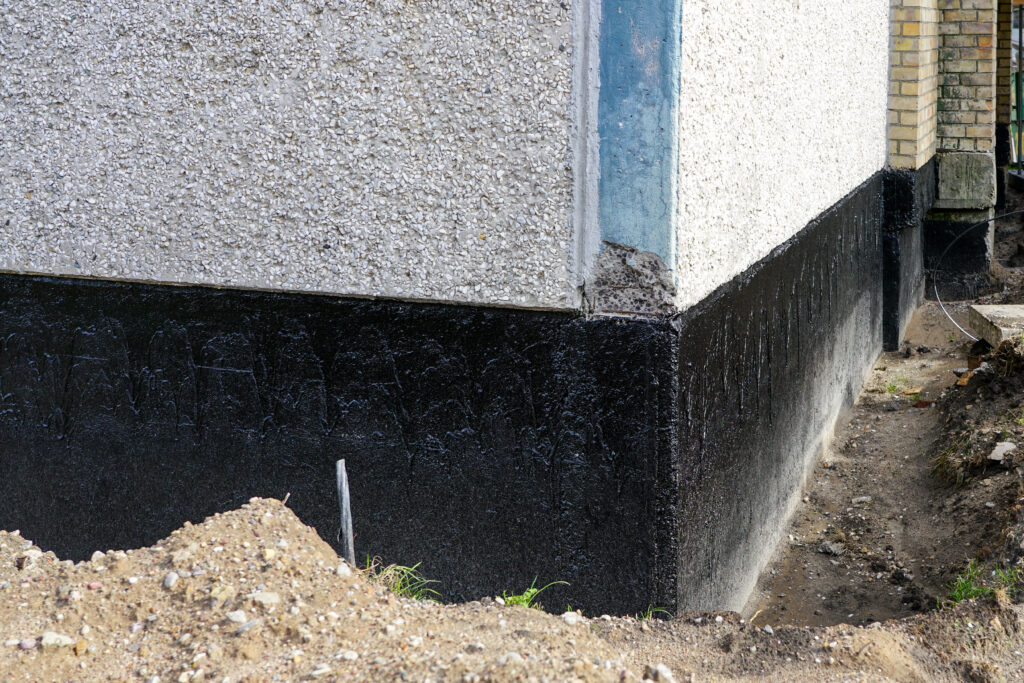
New home waterproofing is one of the most consequential decisions made during construction, and one of the easiest to underestimate. Done correctly during the build phase, it protects your foundation, framing, and interior finishes for decades. Done poorly, it leads to basement flooding, mold, rot, and foundation cracks that can cost $10,000 to $30,000 or more to remediate later. This guide walks through every major waterproofing step for new construction, from site grading to interior sealants, so you understand what should be happening and why.
New Home Waterproofing, Explained
New home waterproofing is a multi-layer system of barriers, drainage, and sealants applied during construction to prevent water from entering the structure through the foundation, walls, or roof.
Unlike waterproofing an existing home (which often involves retrofitting from the inside), new construction waterproofing is applied from the outside during the build. This makes it far more effective and far less expensive to get right the first time. The system typically includes foundation coatings, drainage boards, footing drains, window and door flashing, and exterior wall barriers, all working together to route water away from the structure before it can cause damage.
Key Takeaway: New construction waterproofing is always more cost-effective than fixing water damage later. Upfront systems cost $8,000 to $15,000. Post-construction remediation routinely runs $10,000 to $50,000 or more.
Step 1: Site Grading and Pre-Pour Drainage
The first steps in waterproofing a new home begin before the foundation is poured: proper site grading, soil evaluation, and drainage planning to control water at ground level.
Most water damage in new homes traces back to decisions made before any concrete is poured. Builders assess soil permeability, the water table depth, and the natural drainage patterns on the lot. Clay-heavy soils hold moisture and push hydrostatic pressure against foundation walls. Sandy soils drain well but may require different footing designs.
Actual costs depend on your location, project scope, and materials. The best way to know what you'll pay is to get quotes from local contractors.
Get Your Free Estimate →Need professional help with your project?
Get quotes from top-rated pros.
Find Local ProsThis pre-pour phase is also when the builder installs footing drains (also called French drains or perimeter drains): perforated pipes laid in gravel around the base of the footings that redirect groundwater away from the foundation before it builds up pressure. According to the International Residential Code (IRC), footing drains are required in areas with poorly draining soils or high groundwater.
Pre-pour waterproofing checklist:
- Soil permeability test completed
- Water table depth assessed
- Site graded to drain away from the building footprint
- Footing drain (perimeter drain) design confirmed
- Granular gravel bed specified around footing drains
"We matched with a great contractor the same day. The whole process was easy and completely free."
Step 2: Foundation Waterproofing Membrane
Foundation waterproofing in new construction uses either a dampproofing coat or a full waterproofing membrane applied to the exterior of the foundation walls before backfill is added.
This is the most critical waterproofing step in the entire build, and it’s also where the widest cost and quality variations exist. The table below compares the two main approaches:
| Feature | Dampproofing | Full Waterproofing Membrane |
|---|---|---|
| Material | Asphalt-based spray or brush coat | Rubberized asphalt, sheet membrane, or crystalline product |
| Hydrostatic pressure resistance | No | Yes |
| Best for | Dry climates, well-drained soils | Wet climates, clay soils, basements |
| Typical cost (standard home) | $1,000 to $3,000 | $3,000 to $8,000+ |
| IRC compliance for wet sites | No | Yes |
The Waterproofing Contractors Association distinguishes clearly between these two approaches, noting that only waterproofing membranes (not dampproofing) meet the standard for basements in wet climates.
After the membrane is applied, most builders install a drainage board (a dimple mat or rigid foam board) against the membrane to protect it during backfilling and to create an air gap that allows water to drain down to the footing drain rather than saturating against the wall.
Warning: Dampproofing and waterproofing are not the same thing. If your builder quotes a “waterproofed foundation” but the spec sheet lists a tar or asphalt brush coat, ask specifically whether it is rated to resist hydrostatic pressure. If not, you are getting dampproofing, not waterproofing.
Step 3: Drainage Board and Backfilling
After the foundation membrane is applied, builders install a drainage composite or protection board, then backfill carefully to avoid puncturing the membrane, before moving on to above-grade waterproofing.
The backfilling step is often overlooked, but it matters. Backfilling too aggressively with angular fill, large rocks, or heavy equipment can tear or puncture the membrane, creating voids that allow water infiltration. Proper backfill should use granular material (gravel or sand) closest to the foundation and compactible soil toward the exterior grade.
The finished grade should slope away from the house at a minimum of six inches over the first ten feet, a requirement codified in most residential building codes and a detail that inspectors check during final walkthroughs.
Backfill best practices:
- Use clean gravel or coarse sand in the first 12 to 18 inches against the membrane
- Avoid angular rock or construction debris that can puncture the membrane
- Compact backfill in lifts (layers) to prevent settlement
- Confirm final grade slopes away from the foundation at the code-required minimum
Step 4: Weather-Resistive Barrier on Above-Grade Walls
Above-grade walls in new homes are waterproofed using a weather-resistive barrier (WRB): typically house wrap or building paper installed over the sheathing before siding is applied.
The WRB is the primary line of defense for your walls above the foundation. Products like Tyvek HomeWrap or Typar Building Wrap are the most common, and they work by allowing water vapor to pass outward from the wall assembly while blocking liquid water from penetrating inward. Proper installation requires:
- The wrap overlaps correctly (shingle-style, with upper layers over lower layers)
- All seams are taped with compatible tape
- The wrap integrates with window and door flashing at every opening
- Any tears or punctures from fasteners are patched before siding is installed
A WRB that is improperly lapped or untaped at seams provides minimal protection. Wind-driven rain can exploit even small gaps. According to the Building Science Corporation, faulty WRB installation is among the most common causes of moisture-related wall damage in new construction.
Why Hire a Licensed Professional
- Licensed & insured — protects you from liability
- Warranty coverage — manufacturers require pro installation
- Code compliance — avoids permit issues
- Faster completion — pros finish in days, not weeks
Step 5: Flashing at Every Penetration and Transition
Flashing is thin metal or flexible membrane material installed at every penetration, joint, and transition in the building envelope to direct water away from vulnerable points.
If the WRB is the wall’s armor, flashing is the seam-sealing at every joint where water is most likely to enter. Skipped or improperly sequenced flashing is one of the leading causes of water intrusion in new homes.
Locations that require flashing in new construction:
- Window sills (pan flashing installed before the window unit goes in)
- Window sides and heads (lapping over the WRB)
- Exterior door thresholds and heads
- Roof-to-wall intersections
- Chimney bases and sides
- Skylight perimeters
- Deck ledger connections
- Pipe and vent penetrations through exterior walls
The National Roofing Contractors Association (NRCA) and major window manufacturers like Andersen and Pella publish detailed flashing installation guides that specify the exact overlap sequences required to maintain warranty coverage.
Tip: Ask your builder which flashing system they use at windows and whether it is fully integrated with the WRB. Fluid-applied flashing (like Dow Flashing Sealant) or self-adhering membranes (like Henry Blueskin) outperform simple metal angle flashing at most openings.
DIY vs. Professional: At a Glance
Step 6: Roof Underlayment and Ice-and-Water Shield
New home roofs are waterproofed using an underlayment layer beneath the finish roofing material, plus ice-and-water shield in vulnerable zones like eaves, valleys, and around penetrations.
Roof waterproofing in new construction has two components working together:
| Component | What It Does | Where It Goes |
|---|---|---|
| Synthetic or felt underlayment | Secondary moisture barrier beneath shingles or tiles | Entire roof deck |
| Ice-and-water shield | Self-adhering rubberized membrane; prevents ice dam leaks | Eaves (first 3 ft.), valleys, all penetrations |
In cold climates, ice dams can force water under shingles. Ice-and-water shield prevents that water from reaching the roof deck and causing rot or interior leaks. Most building codes require ice-and-water shield at eaves in climate zones 5 and above.
Spring and summer are the busiest seasons for home improvement projects — top-rated contractors book up fast. Lock in your estimate now before demand peaks.
Check Availability in Your Area →Step 7: Interior Vapor Barriers and Ventilation
Interior waterproofing steps in new homes include vapor barriers in crawl spaces and basements, moisture-resistant drywall in bathrooms, and proper ventilation to prevent condensation buildup.
Interior waterproofing is the last line of defense, not the primary strategy. Key components include:
- Basement vapor barrier: A polyethylene sheet (6 mil minimum, 20 mil in wet climates) laid over the ground before the concrete slab or any framing is installed
- Crawl space encapsulation: Lining the floor and walls with a heavy-duty barrier to eliminate ground moisture; Energy Star’s guidelines for new homes increasingly recommend this over traditional vented crawl spaces
- Moisture-resistant drywall: Cement board or moisture-resistant gypsum (greenboard) used in bathrooms, laundry rooms, and other wet areas
- Ventilation: Bath fans, attic ventilation, and ERVs (energy recovery ventilators) in tightly sealed homes reduce the moisture load on the building’s materials throughout
Common Mistake: Some builders treat interior vapor barriers as the primary waterproofing layer. They are not. Interior barriers only manage moisture that has already entered or condensed. Exterior foundation membranes, WRBs, and drainage are what actually keep water out.
How Much Does New Home Waterproofing Cost?
New home waterproofing typically adds $8,000 to $15,000 to the construction cost of a standard single-family home, depending on foundation type, climate, soil conditions, and the waterproofing system used.
| Waterproofing Component | Typical Cost Range |
|---|---|
| Foundation membrane and drainage board | $3,000 to $8,000 |
| Weather-resistive barrier (WRB) and flashing | $1,500 to $3,500 |
| Roof underlayment and ice-and-water shield | $1,000 to $2,500 |
| Interior vapor barriers and crawl space encapsulation | $1,500 to $4,000 |
| Total (standard single-family home) | $8,000 to $15,000 |
These figures cover the waterproofing components only and do not include the structural foundation itself. Builders in high-rainfall regions, flood zones, or areas with clay soils typically spec more robust systems, pushing costs toward the higher end.
For context, the cost of fixing water damage after the fact (mold remediation, foundation crack injection, or interior drainage system installation) routinely runs $10,000 to $50,000 or more, making upfront waterproofing one of the highest-ROI investments in new construction.
Ready to Move Forward?
Tell us about your project and get matched with up to 3 pre-screened contractors. Compare quotes, check reviews, and hire with confidence.
Questions to Ask Your Builder Before Signing
Ask your builder whether they use a full waterproofing membrane or just dampproofing on the foundation, what WRB product is specified, and who installs and inspects the flashing.
Most buyers don’t probe their builder’s waterproofing specifications until after they’ve signed a contract, at which point changes are expensive. Before signing, ask:
- Is the foundation system dampproofing or a full waterproofing membrane rated for hydrostatic pressure?
- What is the specific product name and brand (not just “waterproof coating”)?
- Is a drainage composite board installed against the membrane before backfill?
- Which WRB product is used, and how are seams taped?
- Which flashing system is used at windows and doors?
- Does a third-party inspector review the waterproofing before backfill is added?
- What does the builder warranty cover for water intrusion, and for how long?
Note: Most structural warranties cover water leaks for 10 years, but coverage often depends on whether proper waterproofing was installed per spec. Get the waterproofing specification in writing as part of your contract.
The Bottom Line
Waterproofing a new home is a layered system, not a single product or step. It starts at grade with drainage and site preparation, moves through the foundation membrane and drainage board, continues through the WRB and flashing on above-grade walls, and finishes with roof underlayment and interior vapor control. Each layer depends on the others, and a gap in any one of them creates a pathway for water.
For buyers, the most important thing is to verify your builder’s waterproofing specifications before construction begins, not after the walls are up. For builders and contractors, following manufacturer installation instructions precisely and allowing third-party waterproofing inspections are the two practices most strongly associated with long-term performance.
Need help finding a qualified waterproofing contractor for your new home or renovation? Compare vetted local contractors to get transparent pricing and verified reviews.
Connect with top-rated local contractors who can help you with siding, roofing, HVAC, windows, and more. Get free quotes from verified professionals in your area today.