

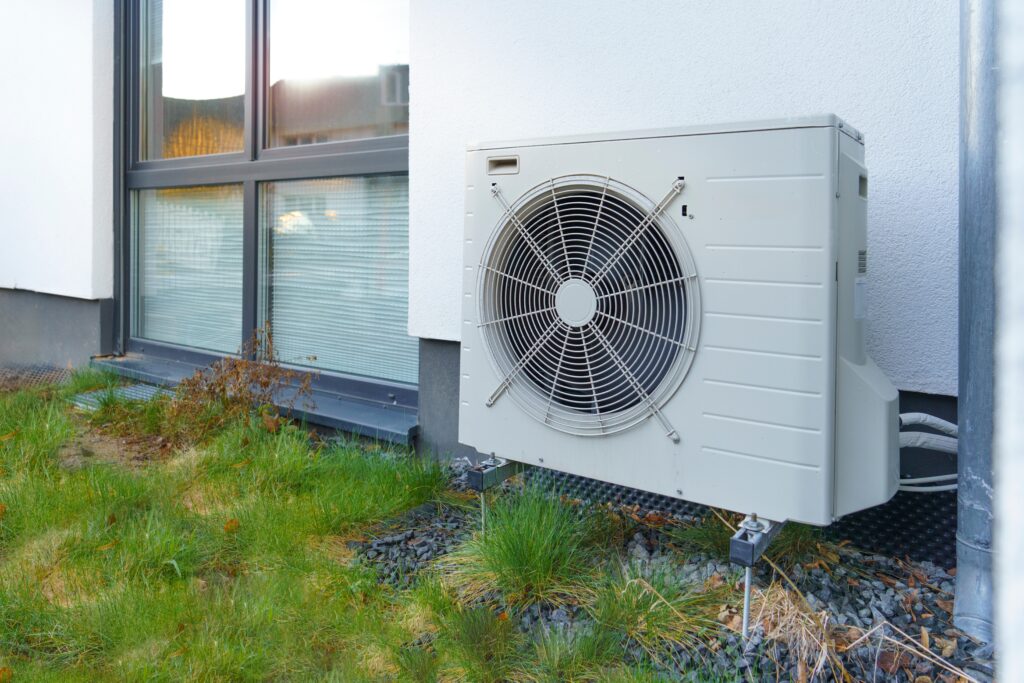
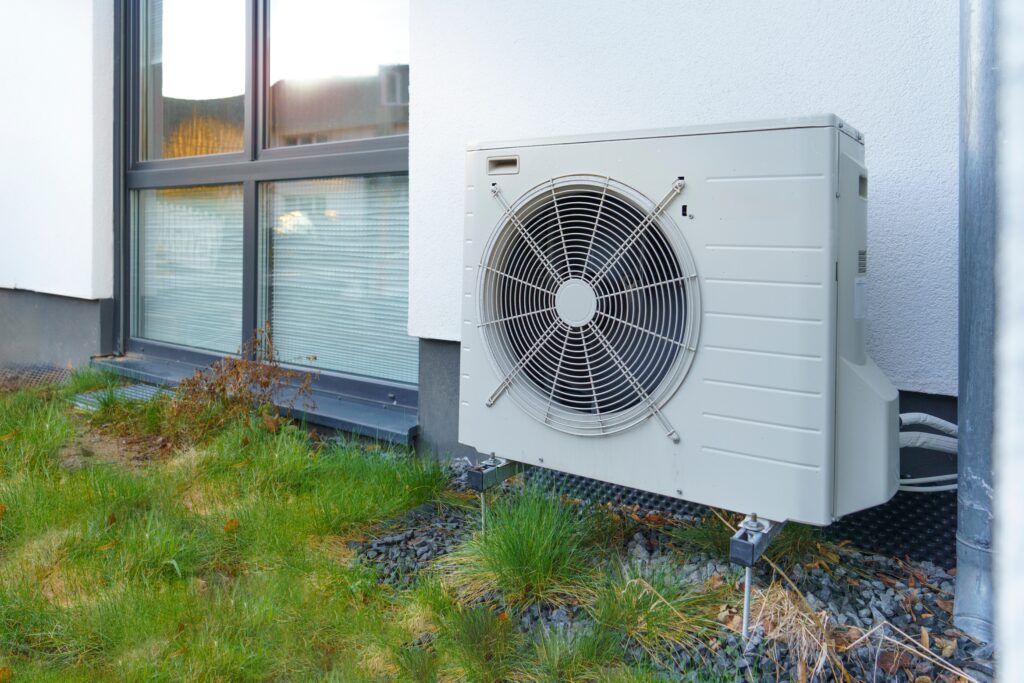
A heat pump is an all-in-one system that handles both heating and cooling, offering a highly efficient alternative to traditional furnaces and air conditioners. For most households, it offers a straightforward way to maintain comfort year-round while reducing energy use.
This guide breaks down what they are, how they work, and if one is the right choice for your home and budget.
How Does a Heat Pump Work?
The simplest way to think of a heat pump is as a two-way air conditioner. It works by moving heat energy from one place to another using a circulating refrigerant and a process called the vapor-compression refrigeration cycle. Unlike a furnace that creates heat by burning fuel, a heat pump transfers existing heat, which makes it highly energy-efficient.
The primary components involved in this cycle are the compressor, two heat exchanger coils (one indoors and one outdoors), an expansion valve, and a reversing valve.
The Four Steps of the Refrigeration Cycle
The process continuously converts a refrigerant between liquid and gas states through changes in pressure and temperature.
- Compression – The compressor increases the pressure and temperature of the refrigerant gas, turning it into a hot, high-pressure vapor.
- Condensation (Heat Release) – The hot vapor flows through a coiled heat exchanger called the condenser. A fan blows air across the coil, and because the refrigerant is hotter than the surrounding air, it releases heat. As it cools, the refrigerant condenses into a high-pressure liquid.
- Expansion – The liquid refrigerant passes through an expansion valve or metering device, which sharply reduces its pressure. This causes the liquid to expand and cool, becoming a cold, low-pressure liquid–vapor mixture.
- Evaporation (Heat Absorption) – The cold refrigerant moves through another coiled heat exchanger known as the evaporator. Air from the surrounding environment is blown across the coil, and since the refrigerant is colder, it absorbs heat and evaporates back into a gas. The low-pressure gas then returns to the compressor to restart the cycle.
Actual costs depend on your location, project scope, and materials. The best way to know what you'll pay is to get quotes from local contractors.
Get Your Free Estimate →Heating vs. Cooling Modes
The key component that allows a heat pump to both heat and cool a home is the reversing valve. This valve changes the direction of the refrigerant flow, swapping the roles of the indoor and outdoor coils.
- Heating Mode – The outdoor coil acts as the evaporator, absorbing heat from the outside air (even in cold weather), while the indoor coil acts as the condenser, releasing that heat inside the home.
- Cooling Mode – The process reverses. The indoor coil becomes the evaporator, absorbing heat from indoor air, while the outdoor coil becomes the condenser, releasing heat outside—just like a central air conditioner.
By moving heat from a cooler location to a warmer one, a heat pump transfers several times more thermal energy than the electrical energy it uses, making it exceptionally efficient.
What Are the Main Types of Heat Pumps?
The main types of heat pumps are categorized primarily by the medium they use to exchange heat (air, ground, or water) and how they distribute that heat (ducted or ductless).
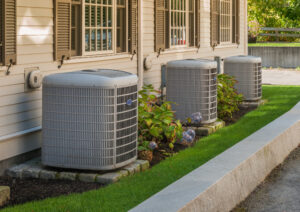
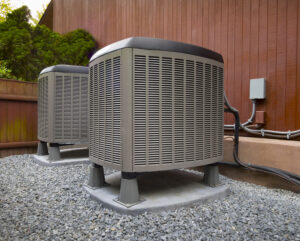
- Air-Source Heat Pumps: The most common type. They look just like a central AC unit and use your home’s existing ductwork to distribute air.
- Ductless Mini-Splits: A great option for homes without ducts (like those with boilers) or for new additions. A ductless system has an outdoor unit connected to one or more indoor “heads” mounted on the wall or ceiling.
- Geothermal Heat Pumps: The most efficient and most expensive option. Geothermal systems use pipes buried deep in the ground, which stays at a constant temperature (around 55°F) year-round, to transfer heat.
Pros and Cons of Heat Pumps
Heat pumps offer huge benefits, but they aren’t the right fit for every home.
"We matched with a great contractor the same day. The whole process was easy and completely free."
The Pros
- All-in-One System: A single unit provides both heating and cooling, simplifying your HVAC setup.
- High Energy Efficiency: Because they move heat instead of creating it, heat pumps are far more energy-efficient than furnaces, which can lower your energy bills.
- Eco-Friendly: They don’t burn fossil fuels like natural gas or oil, reducing your home’s carbon footprint.
The Cons
- High Upfront Cost: A new system is a major investment, costing thousands more than a traditional furnace or AC.
- Performance in Extreme Cold: While modern “cold climate” models are better, many heat pumps struggle when temperatures drop near or below 0°F. They must then rely on a less-efficient “emergency heat” strip, which can spike your electric bill.
- Complex Installation: A heat pump installation is more complex than a simple furnace swap.
How Much Does a Heat Pump Cost
The main drawback of a heat pump is its upfront cost. A new air-source heat pump typically costs between $8,000 and $25,000, including installation. The final price depends on your home’s size, the unit’s efficiency, and your location. A geothermal (ground-source) heat pump costs more, usually between $20,000 and $50,000 or higher, but it offers greater long-term energy savings. These high upfront costs can often be reduced through tax credits and rebates.
Federal Tax Credits (Inflation Reduction Act)
Tax credits can significantly lower the total cost of installing a new heat pump. Two key federal programs are available.
Energy Efficient Home Improvement Credit (25C)
Provides a 30 percent tax credit on the project cost, capped at $2,000 per year, for qualified air-source heat pumps and heat pump water heaters installed in a primary residence. This credit is available through December 31, 2025.
Residential Clean Energy Credit (25D)
Offers a 30 percent tax credit on the total installation cost for geothermal heat pumps, with no annual or lifetime cap. This credit remains available through 2032.
Combined Annual Cap
Homeowners can potentially claim up to $3,200 in total tax credits per year by combining the $2,000 heat pump credit with up to $1,200 in credits for other qualifying improvements such as insulation, electrical panel upgrades, or energy-efficient windows.
Why Hire a Licensed Professional
- Licensed & insured — protects you from liability
- Warranty coverage — manufacturers require pro installation
- Code compliance — avoids permit issues
- Faster completion — pros finish in days, not weeks
Federal Rebates (HOMES and HEEHRP Programs)
The High-Efficiency Electric Home Rebate Program (HEEHRP), created under the Inflation Reduction Act, provides direct rebates for heat pumps and related upgrades. These rebates are income-based and administered at the state level, meaning the specific rebate amounts vary by location. Eligible households can receive substantial financial support that covers a large portion of installation costs.
State and Local Incentives
Many states, municipalities, and utility companies also offer rebates, low-interest financing, or energy-efficiency incentives to promote heat pump adoption. These programs can often be combined with federal tax credits, significantly lowering out-of-pocket expenses.
For the most accurate and up-to-date information, contact your local utility provider or a licensed HVAC professional. They can help identify available programs and estimate your total savings before installation.
DIY vs. Professional: At a Glance
Heat Pump vs. Furnace: Which Is Better?
A heat pump delivers high efficiency in mild or moderate weather and provides both heating and cooling in one system. A furnace, on the other hand, offers stronger and more reliable heating performance in regions that experience very cold winters.
Comparison: Heat Pump vs Furnace
| Factor | Heat Pump | Furnace |
| Technology | Moves heat from one place to another using electricity. | Generates heat by burning fuel such as natural gas, oil, or propane, or by using electric coils. |
| Function | Heats and cools a home in one system, acting as both a heater in winter and an air conditioner in summer. | Heats a home only. A separate air conditioning unit is required for cooling. |
| Energy Efficiency | Highly efficient (up to 300% or more) because it transfers heat instead of creating it, especially in mild to moderate climates. | Less efficient (high-efficiency models typically 95–98%) since some heat is always lost during combustion. |
| Climate Suitability | Most efficient in mild to moderate climates. For very cold regions, a cold-climate heat pump or dual-fuel system is recommended. | Best for very cold climates where strong, consistent heat is needed. Performance is not affected by freezing outdoor temperatures. |
| Operating Cost | Can be lower than a gas furnace in moderate climates, depending on local electricity and fuel prices. If electricity is expensive, operating costs may be higher. | Can be lower than a heat pump if natural gas is affordable in your area. Costs vary with fuel prices. |
| Environmental Impact | Lower carbon footprint since it uses electricity and avoids on-site combustion. Its impact decreases as the electrical grid becomes cleaner. | Higher carbon footprint because it burns fossil fuels such as natural gas. |
| Lifespan | Typically 10–15 years, since it operates year-round for heating and cooling. | Typically 15–20 years, since it operates only during the heating season. |
| Safety | Safer because it does not use combustion, eliminating the risk of carbon monoxide leaks. | Carries a small risk of carbon monoxide leaks if not properly vented and maintained. |
| Comfort | Produces a milder, more consistent heat that can feel cooler than the strong output of a furnace. | Delivers a powerful burst of heat that warms a home quickly. |
Which System Is Right for You
A heat pump is an excellent choice if you live in a mild or moderate climate (zones 1–4) and want to combine heating and cooling in one efficient system. It is especially appealing if you are focused on lowering your carbon footprint and reducing long-term energy costs.
In colder regions (zones 5–7) with harsh winters, a high-efficiency gas furnace may be the better option since it provides stronger, more reliable heat during extreme temperatures and often comes with a lower upfront installation cost.
If you live in a cold climate but still want to benefit from a heat pump’s efficiency during milder weather, consider a dual-fuel system. This setup pairs a heat pump with a gas furnace, allowing the heat pump to handle most of the heating while the furnace automatically takes over during extreme cold snaps.
Spring and summer are the busiest seasons for home improvement projects — top-rated contractors book up fast. Lock in your estimate now before demand peaks.
Check Availability in Your Area →How Long Do Heat Pumps Last?
You can expect a standard air-source heat pump to last 12 to 15 years—similar to a central air conditioner. A geothermal system’s underground loop can last 25 years or more.
Like any HVAC system, the lifespan depends on regular HVAC maintenance. You’ll need to change your filters monthly and get a professional tune-up each year.
Understanding Heat Pump Efficiency Ratings
When shopping for a heat pump, you will encounter several ratings that indicate its energy efficiency. Understanding these metrics is essential for choosing a system that provides the best long-term energy savings.
Effective January 1, 2023, the U.S. Department of Energy (DOE) introduced updated testing procedures and a new scale of efficiency measurements. These newer standards are identified by a “2” at the end of each acronym — SEER2, EER2, and HSPF2.
Ready to Move Forward?
Tell us about your project and get matched with up to 3 pre-screened contractors. Compare quotes, check reviews, and hire with confidence.
Key Efficiency Ratings Explained
| Rating | Stands For | Measures | Higher Number Means… |
| SEER2 | Seasonal Energy Efficiency Ratio 2 | Cooling efficiency over an entire cooling season (replaces SEER). | Greater cooling efficiency and lower summer energy bills. |
| EER2 | Energy Efficiency Ratio 2 | Cooling efficiency at a specific, constant peak condition (95°F outdoor temperature and 80°F indoor temperature). | Better performance during the hottest days and lower peak energy costs. |
| HSPF2 | Heating Seasonal Performance Factor 2 | Heating efficiency over an entire heating season (replaces HSPF). | Greater heating efficiency and lower winter energy bills. |
Understanding the Ratings
Higher efficiency ratings translate to lower operating costs, greater comfort, and a smaller carbon footprint. When comparing models, aim for the highest SEER2, EER2, and HSPF2 ratings your budget allows as they directly impact both your energy bills and long-term savings.
SEER2 (Seasonal Energy Efficiency Ratio 2)
SEER2 measures a heat pump’s cooling efficiency over a full season with varying temperatures. A higher SEER2 rating means the system uses less electricity to cool your home. The current minimum standard for new heat pumps is about 14.3 SEER2, while high-efficiency models can reach 21 SEER2 or higher.
EER2 (Energy Efficiency Ratio 2)
EER2 evaluates efficiency under specific high-demand conditions, such as when outdoor temperatures reach 95°F. This rating is particularly important in regions with long, hot summers, as it reflects how well the system maintains performance during extreme heat.
HSPF2 (Heating Seasonal Performance Factor 2)
HSPF2 measures how efficiently a heat pump provides heating throughout the winter season. The higher the HSPF2, the less energy the unit consumes to keep your home warm. The national minimum for new split-system heat pumps is 7.5 HSPF2, and high-efficiency units often rate 9.0 or higher.
Conclusion
Heat pumps deliver year-round comfort with impressive energy efficiency and potential savings on utility costs. They offer a practical way to heat and cool your home while using less energy and reducing environmental impact.
To find the best option for your needs, consider getting quotes from several qualified installers and checking for local incentives or rebates. For tailored advice and accurate cost estimates, connect with licensed HVAC professionals in your area who can help you choose the right system for your home.
Connect with top-rated local contractors who can help you with siding, roofing, HVAC, windows, and more. Get free quotes from verified professionals in your area today.