

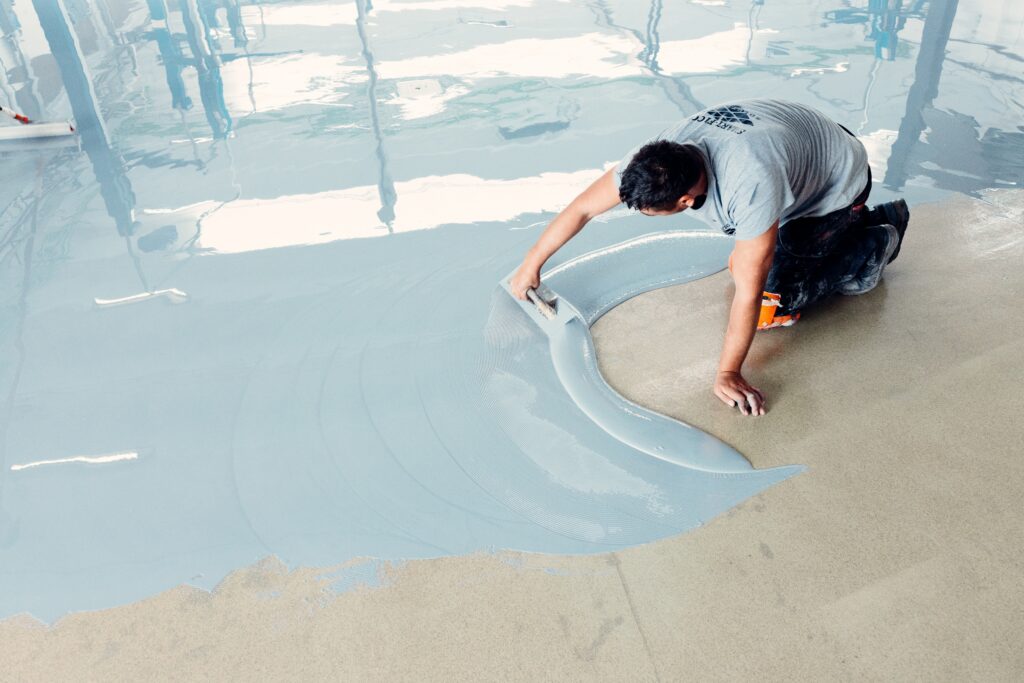
That glossy, showroom-quality floor you keep seeing in garage makeover videos isn’t polished concrete. It’s epoxy, and it costs a fraction of what most homeowners expect. Professional epoxy flooring runs $4 to $12 per square foot installed, while DIY kits drop that number to $2 to $5 per square foot for materials alone.
But the price tag only tells part of the story. The type of epoxy you choose, the condition of your concrete slab, and whether you hire a pro or tackle it yourself can swing your total project cost by thousands of dollars. This guide breaks down real pricing by epoxy type and garage size, explains how long each option actually lasts, and helps you decide whether the DIY route is worth the risk.
How Much Does Epoxy Flooring Cost Per Square Foot?
Epoxy flooring costs $4 to $12 per square foot installed, with most homeowners spending $1,600 to $5,800 for a two-car garage.
Material costs alone range from $1 to $5 per square foot depending on the epoxy type. Labor adds another $3 to $7 per square foot, and most contractors send a two-person crew to complete the job within one to two days. The final number depends heavily on your resin choice, floor condition, and project size.
| Epoxy Type | Materials Per Sq Ft | Installed Per Sq Ft | Two-Car Garage (400 Sq Ft) |
|---|---|---|---|
| Water-Based | $1 – $2 | $4 – $6 | $1,600 – $2,400 |
| Solvent-Based | $2 – $3 | $5 – $8 | $2,000 – $3,200 |
| 100% Solid | $3 – $5 | $6 – $10 | $2,400 – $4,000 |
| Metallic | $4 – $6 | $8 – $15 | $3,200 – $6,000 |
| Flake/Chip | $3 – $4 | $5 – $10 | $2,000 – $4,000 |
| Quartz | $4 – $5 | $8 – $12 | $3,200 – $4,800 |
Larger projects often see lower per-square-foot pricing because of bulk material savings and more efficient labor scheduling. A 600-square-foot three-car garage might cost $7 per square foot installed, while a 200-square-foot single-car garage could run $10 or more for the same epoxy type.
What Factors Affect the Total Cost of Epoxy Flooring?
Floor size, concrete condition, epoxy type, and labor rates are the four biggest variables that determine your final epoxy flooring cost.
Your garage size is the primary cost driver because it dictates how much material and labor you need. But the condition of your existing concrete slab can add hundreds or even thousands to the total if repairs are necessary before application.
Concrete Condition and Surface Prep
Epoxy bonds directly to concrete, and any cracks, oil stains, or moisture issues must be resolved first. Basic crack patching runs $25 to $250, but extensive damage may require full concrete resurfacing at $3 to $7 per square foot. If cracks signal deeper structural problems, foundation repair costs can reach $2,150 to $7,730.
Most installers also acid-etch or diamond-grind the surface to create a rough profile for proper adhesion. This prep step costs $50 to $100 and is usually included in the contractor’s bid.
Concrete Hardness and the Mohs Scale
Contractor bids can fluctuate based on the physical hardness of your existing slab. Professional installers often test the concrete using a specialized scratch kit based on the Mohs Hardness Scale.
If the concrete is unusually soft, it will absorb primer coats like a sponge, requiring additional material to seal properly. Conversely, if the concrete is exceptionally hard, standard diamond grinding discs will glaze over without creating the necessary surface profile. Preparing extremely hard concrete requires specialized, soft-bond diamond segments that wear down quickly, prompting many contractors to add an equipment surcharge of $1 to $2 per square foot. Additional guidelines on preparing concrete surfaces can be found through ASTM International.
Epoxy Type and Finish
Water-based epoxy is the budget option, but it produces a thinner coating that wears faster. 100% solid epoxy costs more upfront and delivers the thickest, most durable finish. Decorative options like metallic swirls or vinyl flake broadcasts add visual appeal but increase both material and labor costs.
Actual costs depend on your location, project scope, and materials. The best way to know what you'll pay is to get quotes from local contractors.
Get Your Free Estimate →Geographic Location
Labor rates vary significantly by region. Urban areas with higher costs of living typically charge $5 to $7 per square foot for labor, while rural markets may fall closer to $3 to $4 per square foot. Always collect at least three local bids before committing.
Project Scope
Coating a garage floor is the most common residential application, but epoxy also works on basement floors, patios, and driveways. Outdoor applications require UV-stable formulations that cost more than standard indoor epoxy. If you are exploring options for waterproof flooring in basements, epoxy is one of the more resilient choices.
What Are the Different Types of Epoxy Flooring?
Epoxy flooring ranges from budget water-based coatings to premium metallic finishes, each with distinct durability and cost profiles.
Not all epoxy is the same. The term covers several product categories with major differences in solids content, thickness, chemical resistance, and lifespan. Choosing the right type depends on your budget, the room’s traffic level, and how long you want the coating to last.
Water-Based Epoxy
Water-based formulas are the thinnest option at around 40% to 60% solids content. They cost $30 to $50 per gallon and are the easiest to apply because of lower odor and simpler cleanup. The tradeoff is a shorter lifespan of one to three years in high-traffic areas, making them better suited for light-duty spaces like laundry rooms or storage areas.
"We matched with a great contractor the same day. The whole process was easy and completely free."
The Relationship Between Wet Mils and Dry Mils
To understand why budget epoxies fail faster, you must look at the relationship between wet film thickness (WFT) and dry film thickness (DFT), measured in mils (one-thousandth of an inch).
When you apply a water-based or solvent-based epoxy that is only 50% solids by volume, half of the wet layer evaporates into the air as the product cures. If an installer rolls down a 10-mil thick wet layer, you are left with a fragile 5-mil dry coating. 100% solid epoxies contain no carrier fluids or water to evaporate, meaning a 10-mil wet application cures to exactly 10 dry mils. A high-quality residential garage floor system should maintain a cumulative thickness of 15 to 20 dry mils across the primer, base, and topcoats to withstand vehicle weight. You can review industrial coating standards via the Association for Materials Protection and Performance.
Solvent-Based Epoxy
Solvent-based products deliver better adhesion and chemical resistance than water-based options. They run $40 to $55 per gallon and produce moderate fumes during application, requiring good ventilation. Expect three to five years of performance in a residential garage.
100% Solid Epoxy
This is the professional standard. With no solvents or water to evaporate, 100% solid epoxy cures into the thickest possible coating. It costs $45 to $150 per gallon and typically lasts 10 to 20 years in residential settings. The thicker application makes it more difficult to work with, which is one reason most homeowners hire a pro for this type.
Metallic Epoxy
Metallic pigments create a three-dimensional, marble-like appearance that makes each floor unique. This is the most expensive option at $8 to $15 per square foot installed, and it requires professional application to achieve consistent results. It performs best in show garages, basements, and finished interior spaces.
Flake and Chip Epoxy
Decorative vinyl flakes are broadcast into the wet epoxy base coat to create a textured, granite-like surface. The flakes add slip resistance and help hide minor imperfections. This system runs $5 to $10 per square foot installed, making it one of the most popular choices for residential garage and home flooring.
How Long Does Epoxy Flooring Last?
Professionally installed epoxy flooring lasts 10 to 20 years in residential settings, with premium systems exceeding 20 years.
Lifespan varies dramatically based on three factors: the epoxy type, installation quality, and daily wear. A 100% solid epoxy system with a polyaspartic or urethane topcoat in a residential garage can easily surpass 15 years. A big-box store DIY kit in the same space might start peeling within 12 to 18 months.
| Epoxy System | Typical Lifespan | Best For |
|---|---|---|
| DIY Kit (Water-Based) | 1 – 3 years | Light storage, laundry rooms |
| Solvent-Based | 3 – 5 years | Moderate-traffic garages |
| 100% Solid (Professional) | 10 – 20 years | Residential garages, basements |
| Commercial-Grade | 10 – 20 years | Warehouses, retail, showrooms |
| Industrial Multi-Layer | 20 – 30+ years | Manufacturing, heavy equipment |
Surface preparation is the single biggest predictor of how long your floor will last. Mechanical grinding or diamond grinding creates a surface profile that allows the epoxy to bond at the molecular level. Skipping this step, or relying only on acid etching, is the most common reason epoxy coatings fail prematurely.
Plasticizer Migration and Hot-Tire Pickup
The premature peeling associated with cheap DIY kits is caused by a chemical phenomenon called plasticizer migration, commonly known as hot-tire pickup. Modern automotive tires contain specialized polymer compounds called plasticizers to keep the rubber flexible and pliable.
When you drive your vehicle, friction generates significant heat within the tires. When you park the hot vehicle on a thin, water-based or solvent-based epoxy coating, the heated plasticizers relax and migrate directly into the floor finish. This migration chemically softens the thin epoxy film. As the tire cools, it fuses with the softened floor coating. When you back the vehicle out of the garage, the tire tread pulls the epoxy completely away from the concrete slab. High-density, 100% solid epoxies feature an tightly cross-linked molecular structure that prevents this chemical migration. Homeowners can read more about hot-tire dynamics via the Concrete Network.
Critical Warning: Moisture in the concrete slab is the leading cause of epoxy failure. Before any application, a professional should perform a calcium chloride moisture test or an in-situ relative humidity test. Slabs with moisture readings above 75% relative humidity will cause the coating to blister and delaminate. Addressing basement moisture problems before coating is essential.
Why Hire a Licensed Professional
- Licensed & insured — protects you from liability
- Warranty coverage — manufacturers require pro installation
- Code compliance — avoids permit issues
- Faster completion — pros finish in days, not weeks
Advanced Moisture Mitigation and the MVT Layer
If a concrete slab fails an ASTM F2170 relative humidity test by scoring above 75%, standard epoxies cannot be applied without failing. Ground moisture moving upward through the porous concrete creates hydrostatic pressure, forming bubbles under the cured floor coating.
To resolve this issue, professional installers apply an Epoxy Moisture Vapor Transmission (MVT) barrier primer. These specialized, deep-penetrating primers are chemically engineered to withstand vapor pressure up to 20 or 25 pounds per 1,000 square feet over a 24 hour window. Incorporating an MVT barrier adds an extra layer to the process, increasing overall material costs by $1.50 to $2.50 per square foot, but it prevents systemic delamination on damp slabs.
Adding a UV-stable topcoat (urethane or polyaspartic) over the epoxy base prevents yellowing and chalking from sunlight exposure. This step adds $2 to $5 per square foot but can extend the floor’s appearance and functional life by several years. Proper maintenance also plays a role. Keeping the surface free of abrasive grit and cleaning spills promptly will help you extend the life of your flooring investment.
Can You Install Epoxy Flooring Yourself?
DIY epoxy installation costs $2 to $5 per square foot for materials, but improper surface prep causes most DIY floors to fail.
Epoxy kits from home improvement stores make the process look simple. The reality is that professional-quality results depend on precise surface preparation, temperature and humidity control during application, and correct mixing ratios. Missing any of these steps leads to peeling, bubbling, or uneven curing.
What a DIY Installation Requires
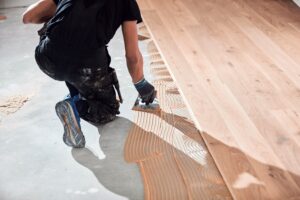
A proper DIY job takes a full weekend, sometimes longer. You need to clear the entire garage, repair any cracks, degrease the surface, acid-etch or mechanically grind the concrete, and allow it to fully dry before applying the first coat. Most kits include a base coat and a topcoat, with flake options available as add-ons.
The tools you will need include a spiked roller, squeegee, mixing paddle, and personal protective equipment. If you do not already own these, budget an extra $50 to $100.
DIY vs. Professional: At a Glance
Where DIY Falls Short
The biggest issue is surface prep. Most DIY kits recommend acid etching, which creates a weaker bond than the diamond grinding that professionals use. The thinner coatings in retail kits are also more prone to hot-tire pickup, where the heat from parked car tires softens the epoxy and pulls it up when you drive away.
Pro Tip: If you choose the DIY route, invest in a concrete grinder rental ($50 to $75 per day) instead of relying on the acid etch solution included in most kits. Mechanical grinding produces a far better surface profile and significantly improves adhesion.
Temperature is another critical variable. Epoxy should be applied when the ambient temperature is between 60°F and 85°F with humidity below 85%. Applying outside these conditions causes curing defects that cannot be fixed without stripping and restarting the entire project.
DIY vs. Professional Cost Comparison
| Cost Category | DIY | Professional |
|---|---|---|
| Materials (400 Sq Ft) | $800 – $2,000 | Included in bid |
| Tool Rental / Purchase | $50 – $150 | N/A |
| Surface Prep | Your labor | $200 – $600 |
| Application Labor | Your labor | $1,200 – $2,800 |
| Total Estimated Cost | $850 – $2,150 | $1,600 – $5,800 |
The savings look significant on paper, but the risk of failure is real. A botched DIY job often requires professional removal and reapplication, which can cost more than hiring a pro from the start. For homeowners who want to avoid common pitfalls, understanding flooring installation mistakes before you begin can save both time and money.
What Are the Pros and Cons of Epoxy Flooring?
Epoxy flooring delivers exceptional durability and chemical resistance but requires precise installation and has UV limitations.
Every flooring material involves compromises. Epoxy delivers standout performance in several categories but falls short in others. Weighing these factors against your specific needs will help you decide whether it is the right fit.
Advantages of Epoxy Flooring
Durability and Impact Resistance
A properly installed epoxy floor handles vehicle traffic, dropped tools, and heavy equipment without cracking or chipping. Commercial-grade systems routinely perform for over a decade in warehouse environments, and residential applications last even longer with less daily stress.
Chemical and Stain Resistance
Epoxy creates a non-porous, seamless surface that resists oil, gasoline, brake fluid, and most household chemicals. Spills sit on the surface rather than soaking in, making cleanup simple. This is a major advantage over bare concrete, which stains permanently.
Design Versatility
Options range from solid colors and decorative flakes to high-gloss metallic finishes. You can match virtually any aesthetic, from a clean industrial look to a polished showroom floor. If you are weighing different types of flooring for your space, epoxy stands out for its customization range.
Low Maintenance
Regular sweeping and occasional mopping with a pH-neutral cleaner is all that is needed. There is no waxing, sealing, or refinishing required between recoats, which is a significant advantage over hardwood or laminate alternatives.
Spring and summer are the busiest seasons for home improvement projects — top-rated contractors book up fast. Lock in your estimate now before demand peaks.
Check Availability in Your Area →Drawbacks of Epoxy Flooring
Slippery When Wet
Epoxy’s smooth, non-porous surface becomes slick when wet or oily. Adding anti-slip additives like aluminum oxide or silica sand to the topcoat solves this problem at a small additional cost, but it must be specified during installation.
Long Curing Time
Full curing takes five to seven days, during which the floor cannot handle vehicle traffic. Light foot traffic is usually safe after 24 to 48 hours, but you will need to keep your car out of the garage for nearly a week.
UV Sensitivity
Standard epoxy yellows and chalks when exposed to direct sunlight over time. This is primarily an issue for garages with south-facing windows or outdoor applications. A UV-stable polyaspartic or urethane topcoat prevents this but adds to the overall cost.
Installation Complexity
Epoxy is not forgiving. Incorrect mixing, poor surface prep, or applying in the wrong conditions leads to coating failure. Unlike LVP flooring or other click-lock systems that homeowners can install with minimal risk, epoxy demands precision and experience.
How Does Epoxy Compare to Other Garage Flooring Options?
Epoxy outperforms most garage flooring alternatives in durability and chemical resistance but costs more than sealers or paint.
Choosing between epoxy and its alternatives comes down to budget, timeline, and performance priorities. Here is how the most common options stack up.
| Flooring Type | Cost Per Sq Ft (Installed) | Lifespan | Cure/Install Time | Chemical Resistance |
|---|---|---|---|---|
| Epoxy (Professional) | $4 – $12 | 10 – 20 years | 5 – 7 days full cure | Excellent |
| Polyaspartic Coating | $6 – $14 | 15 – 20+ years | 1 day full cure | Excellent |
| Polished Concrete | $3 – $12 | 20+ years | Immediate use | Moderate |
| Concrete Sealer | $1 – $3 | 1 – 3 years | 24 – 48 hours | Low |
| Interlocking Tiles | $3 – $7 | 10 – 15 years | Immediate use | Good |
| Concrete Paint | $1 – $2 | 1 – 2 years | 24 – 48 hours | Poor |
The Hybrid Polyurea and Polyaspartic System
The premium, multi-layer coating packages marketed by national floor refinishing franchises are rarely pure epoxy systems. Instead, the current industry benchmark relies on a high-performance hybrid setup.
This system pairs a polyurea base coat with a polyaspartic topcoat. Polyurea penetrates deeper into the concrete pores than standard epoxy, forming an aggressive mechanical bond while maintaining flexibility to withstand shifting temperatures. The polyaspartic topcoat provides rapid curing properties and total UV resistance, preventing the amber yellowing caused by sunlight exposure. Because this system cures rapidly, a professional crew can complete the preparation and installation in a single day, reducing down time. This hybrid approach commands a premium price of $6 to $14 per square foot.
For homeowners evaluating how different flooring choices affect resale, understanding which floors increase home value can help guide the decision. A well-installed epoxy floor in a garage adds visual appeal and perceived value, even if it does not carry the same ROI as hardwood in a living space.
Ready to Move Forward?
Tell us about your project and get matched with up to 3 pre-screened contractors. Compare quotes, check reviews, and hire with confidence.
Real-World Cost Scenario
To understand how these material selections and floor conditions intersect, look at this typical mid-range pricing example:
- Property Profile: A 420 square foot, two-car residential garage built in 1998 located in a suburban region.
- Floor Condition: The concrete slab exhibits minor pitting, three active cracks, and deep oil stains under the engine locations.
- Project Specifications: Mechanical diamond grinding, crack injection repair, a 100% solid epoxy base coat with a full vinyl flake broadcast, and a UV-stable polyaspartic protective topcoat.
Cost Breakdown
- Surface Prep and Concrete Repair: $450 for four hours of mechanical diamond grinding, degreasing, and epoxy crack injection.
- 100% Solids Base Coat and Vinyl Flake Broadcast: $2,100 for materials and labor.
- Polyaspartic Clear Topcoat: $1,050 for the high-durability final protective layer.
- Total Investment: $3,600
- Final Unit Cost: $8.57 per square foot
How to Hire an Epoxy Flooring Contractor
A qualified epoxy contractor should provide mechanical surface prep, a multi-layer coating system, and a written warranty.
Not all epoxy installers deliver the same quality. The difference between a floor that lasts three years and one that lasts 20 often comes down to the contractor’s preparation process and the products they use.
Get at least three written estimates and ask each contractor these questions before signing.
- What surface preparation method do you use? (Diamond grinding is the professional standard. Acid etching alone is a red flag.)
- What is the total coating thickness in mils?
- How many coats are included in the bid?
- Do you perform a moisture test on the slab before application?
- What type of topcoat do you apply? (Urethane or polyaspartic topcoats indicate a higher-quality system.)
- What does the warranty cover, and for how long?
Red Flags in Contractor Estimates
When comparing local project estimates, exercise caution if you encounter these common omissions:
- Bids Lacking Material Percentages: If an estimate lists generic epoxy without explicitly identifying the solids content, the contractor may be using cheaper water-based options to underbid competitors.
- Absence of Specific Thickness Commitments: The estimate should clearly document the intended wet mil application and the final dry mil thickness across all layers. Bids that skip these measurements often deliver a thin, short-lived finish.
- No Verification of Concrete Testing: Avoid contractors who refuse to perform a moisture check or hardness scratch test prior to drafting their final proposal. Proceeding without this baseline assessment introduces a high risk of localized delamination.
What to Watch For: Be cautious of bids that seem significantly lower than competitors. Budget contractors often skip mechanical grinding, use water-based products instead of 100% solids, or apply a single thin coat. These shortcuts save money upfront but lead to premature failure. Knowing what to expect during a professional flooring installation helps you evaluate whether a contractor’s process meets industry standards.
Ask to see photos of completed projects and check online reviews. A contractor who specializes in epoxy coatings will have a portfolio of garage and commercial work, not just general painting or handyman services. For tips on spotting warning signs during the hiring process, review this guide to professional flooring installation.
The Bottom Line
Epoxy flooring is one of the most cost-effective ways to protect a concrete surface, with professional installs lasting 10 to 20 years.
The key to getting real value from an epoxy floor is investing in proper installation from the start. That means quality surface preparation, the right epoxy system for your space, and a UV-stable topcoat to prevent yellowing. Cutting corners on any of these steps undermines the durability that makes epoxy worth the investment.
Whether you are coating a garage, finishing a basement, or upgrading a workshop, epoxy gives you a seamless, chemical-resistant surface that requires minimal upkeep for years. Compare pricing from local contractors, ask the right questions about their process, and make sure moisture testing is part of every bid.
Connect with top-rated local contractors who can help you with siding, roofing, HVAC, windows, and more. Get free quotes from verified professionals in your area today.